


Fact Check: Stronger Revenue Growth Limit Won’t Trigger Refunds in Tough Economic Times
Proposed changes to Massachusetts’ revenue growth limit, also known as Chapter 62F, will appear on the ballot this fall. Opponents say it will hurt state revenue in tougher economic times. They argue that strengthening the existing limit will provide more tax refunds – even in times of economic downturn for the Commonwealth.
These concerns don’t line up with the historical data.
An MOA analysis found that if the proposed changes to the state’s revenue growth limit had been in place since the law was passed in 1986, taxpayer refunds would not have been triggered in periods of major economic decline. The Commonwealth’s experience in the past several decades suggests refunds occur in times of robust budget growth, acting as a guardrail against the state’s propensity to increase spending.
Proposed Changes Would Not Trigger Refunds in Past Economic Downturns
In the years since Chapter 62F went into place, the Commonwealth has endured some difficult economic cycles, such as the dot-com bust in the early 2000s and the Great Recession that began December 2007 through July 2009. But in the years Massachusetts’ economic growth was negatively impacted, no refunds would have been issued even if the proposed changes had been in place all along.
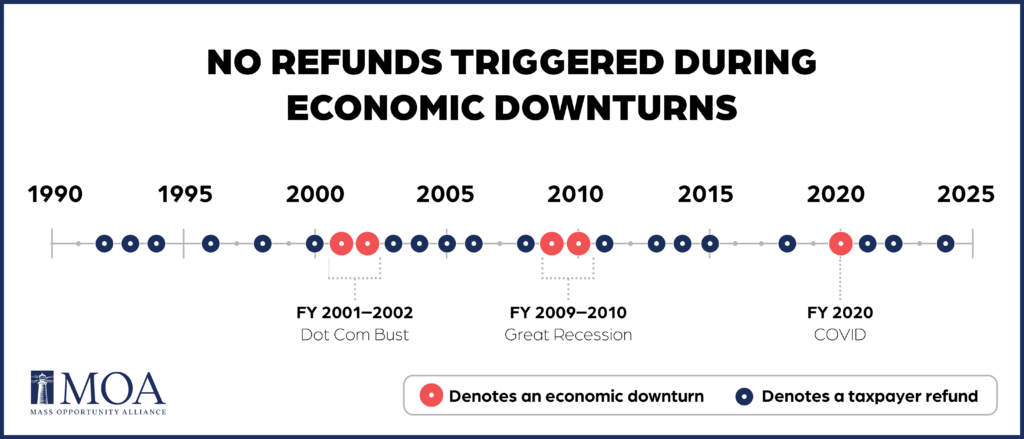
The collapse of the stock market bubble at the turn of the century created economic decline nationwide starting in March 2000, and the primary impacts lasted through October 2002. During this time period, the rate of annual state GDP growth stagnated, dropping from 8.1% growth in 2000 to just 0.1% two years later.
In the two full fiscal years (FY2001 and 2002) in this downturn, Massachusetts still would not have seen refunds to taxpayers if the proposed growth limit changes had been in place. It would not be until Fiscal Year 2003 – when state GDP jumped 2.2% over the previous year and net state revenues grew 4.8%.
Several years later, the Great Recession lasted December 2007 to June 2009. Fiscal Year 2009 was the only full revenue year for Massachusetts during this period. Real state GDP dropped -1.4% and state revenues declined, and as a result would not have triggered a refund to taxpayers. In fact, the state would see two full years of strong GDP growth before triggering a refund for taxpayers in Fiscal Year 2011.
Even during a sharp recessionary period in Spring 2020 due to the COVID-19 pandemic, no refund would have been immediately triggered. It would not have been until FY 2021 and 2022 – when state officials reported “unprecedented” high revenue collections – that the state would see taxpayer refunds under a strengthened revenue growth limit.
Conclusion
The state’s existing limit on yearly revenue growth is an important mechanism that provides refunds to taxpayers when the state collects too much.
The proposed revision to this limit would increase the frequency of refunds, which could represent a much-needed return of cash as taxpayers navigate high costs and an already high tax burden. Previous MOA analysis finds that this change would trigger 10 times the number of refunds that taxpayers have actually received in the law’s four decade history.
Most importantly, looking at Massachusetts’ revenue history, the proposed changes would not make Massachusetts worse off in economic downturns. In two of the most tumultuous declines Massachusetts has endured, even if proposed changes had been in place, refunds would not have been issued. Instead, MOA finds refunds only would have occurred when the economy was growing again.
More from Mass Appeal
Tax or Treat? The Scariest Ideas For Massachusetts’ Economy
Just in time for Halloween, MassBudget released its list of 28 ways to raise taxes on the Commonwealth’s families and businesses. What could be scarier than that?
FACT CHECK: A Growing Consensus on MA’s Competitiveness Problem
The Massachusetts Taxpayers Foundation (MTF) just released its annual competitiveness index, assessing how the Commonwealth stacks up against the rest of the country.
Spoiler alert: Massachusetts maintains many competitive strengths, but is becoming an increasingly difficult place to live and do business.
FACT CHECK: What Question 5 Would Change About Massachusetts’ Revenue Growth Limit
We break down the facts and the myths about Chapter 62F and what a proposed revision would do for taxpayers and the state as a whole.

Want to learn more about opportunity in Massachusetts?