


Competitiveness Is On the Ballot in 2026
Massachusetts voters are gearing up to decide on nine total measures next week. A few of them directly address concerns about affordability and keeping Massachusetts a competitive place to live and work. These include one that would strengthen the limit on how much tax revenue can grow every year, and one that would allow for more starter home development.
But competitiveness issues aren’t limited to the Bay State this election season.
We highlight a few tax-related measures to watch across the country below.
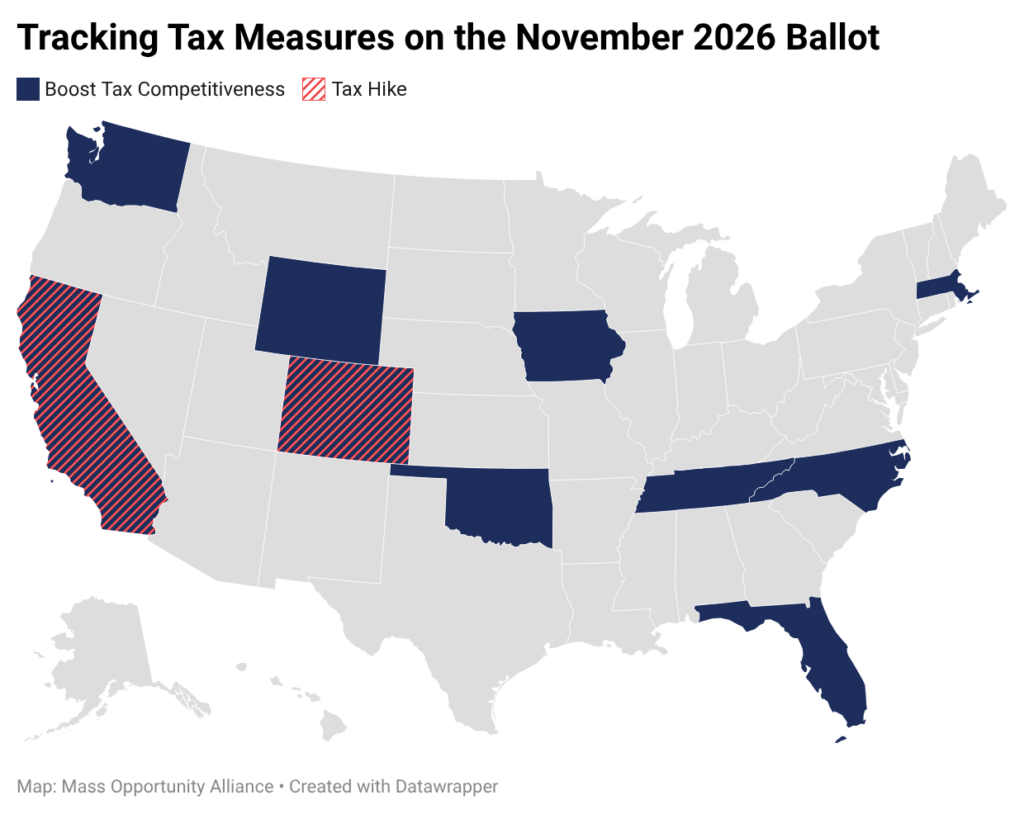
Measures to Boost State Competitiveness
Red and blue states alike are considering income tax reductions or limits.
- In California, Proposition 42 would prohibit any new taxes on ownership of retirement accounts, individually-owned assets like personal property and financial assets, and personal savings. The measure would also prohibit any tax measure from retroactively applying to assets held previously. (This measure is competing with another proposed measure to institute a so-called “wealth” tax.)
- In North Carolina, the “Income Tax Rate Cap Amendment” would amend the state constitution to lower the maximum allowable income tax rate from 7% to 3.5%. North Carolina’s income tax rate has been reduced over the last few years, reaching 3.99% in 2026.
- In Colorado, Proposition 136 would cap future individual and corporate tax rates at the current flat rate of 4.4%. The measure has received support from both sides of the aisle, including Democratic Governor Jared Polis. (This measure is competing with another proposed measure to raise income taxes.)
- In Iowa, Amendment 1 is a constitutional provision that would require any bill proposing a new state income tax or individual or corporate tax hikes be approved by two-thirds of members of the state House and Senate. Right now, any bill passes with a simple majority.
Another tax measure to watch is Washington State’s proposal to repeal the 9.9% income tax rate on million-dollar earners that was enacted earlier this year. The law is scheduled to take effect in 2028, but one survey has found nearly 1 in 4 businesses are already planning their exit. Washington also has one of the highest levels of outmigration in the country according to the latest Internal Revenue Service data, not unlike the Bay State’s own outmigration crisis, in part triggered by its own income tax on incomes over $1 million.
It’s not just income taxes, several states will consider ways to reduce property tax burdens.
- In Florida, Amendment 3 would increase the threshold of a homeowner’s property value that is exempt from being taxed, from the current $25,000 limit up to $150,000 in 2027 and $250,000 in 2028. It would also lower the limit on how much a non-homestead property can grow in assessed value, and restrict how property tax revenue can be used by local governments.
- In Oklahoma, a similar measure (State Question 847) would lower the limit on how much the assessed “fair cash” value of property can grow every year for tax purposes.
- In North Carolina, the “Property Tax Levy Limit Amendment” would create a constitutional provision requiring the state legislature to pass limits on how much local governments can raise property taxes.
- In Tennessee, Amendment 2 would constitutionally prohibit the state legislature from enacting a state property tax. However, this would not affect local governments, most of which currently have their own property tax rates.
- In Wyoming, Initiative 1 would exempt 50% of a homeowner’s property value from being eligible for property taxes. Currently, Wyoming has a state property tax rate of 0.53%, and local governments levy their own property taxes.
Tax Hikes Are Also On the Ballot
While many state measures are aimed at reducing taxes and boosting competitiveness, a few measures are gaining national attention for how they would increase taxes.
California’s Proposition 40 has already triggered a substantial exodus of startup founders and other high-earning taxpayers from the Golden State. Proposition 40 proposes taxing the “wealth” of taxpayers with more than $1 billion in assets. This includes unrealized, non-liquid value of things like property, personal savings accounts, retirement accounts, and shares of businesses they started. The proposal has received pushback from union groups in California, and even the state’s Democratic Governor Gavin Newsom – as some have estimated the flight of high earners has already cost the state $1 trillion in tax revenue.
Another measure on the ballot in California is Proposition 3, which would enshrine recent top marginal income tax rate hikes in the state constitution. These rates range from 10.3% to 12.3% on single filers earning at least $361,000 annually, and joint filers earning at least $721,000 annually. These rates were put in place in 2012, but have had to be extended every few years. Currently, they are set to expire in 2031.
Colorado’s Amendment 87 would eliminate the state’s current 4.4% flat income tax rate with a graduated rate system. While the lowest tax rate would be 3.7% on incomes of $25,000 per year or lower, it would institute much higher income tax rates from 7.4% to 8.4% on incomes over $500,000 a year.
Conclusion
Massachusetts’ voters have said loud and clear they want relief from high costs, including a reduced tax burden. They’ve also expressed concern about how the state’s tax-and-spend policy has negative economic impacts, and the existing high tax environment may be making the state less competitive than others for people to live and start businesses.
These concerns are pushing taxpayers out of Massachusetts. States with some of the highest tax burdens – such as Washington or California – have seen some of the largest outmigration trends in the country. Massachusetts is also experiencing a net loss of residents every year.
Some states have the opportunity to enact measures that make life less costly for residents, potentially making them a more affordable, attractive place to live and do business. Others could be faced with measures that make them even less competitive. Ultimately, it’s up to the voters.
More from Mass Appeal
A Competitive Massachusetts Paves the Way For Charitable Giving
Massachusetts is home to some of the most innovative and successful individuals and companies in the country. When these big-dollar donors are looking for charitable programs and nonprofits to support, they often do so right in their own backyard.
Tax or Treat? The Scariest Ideas For Massachusetts’ Economy
Just in time for Halloween, MassBudget released its list of 28 ways to raise taxes on the Commonwealth’s families and businesses. What could be scarier than that?
FACT CHECK: A Growing Consensus on MA’s Competitiveness Problem
The Massachusetts Taxpayers Foundation (MTF) just released its annual competitiveness index, assessing how the Commonwealth stacks up against the rest of the country.
Spoiler alert: Massachusetts maintains many competitive strengths, but is becoming an increasingly difficult place to live and do business.

Want to learn more about opportunity in Massachusetts?