


New Data Shows Massachusetts’ Competitiveness Challenge Remains
This week, Question 5 – an MOA-inspired idea that would have strengthened our state’s revenue growth limit and triggered more taxpayer refunds – narrowly lost on the ballot.
While MOA is disappointed in the missed opportunity to address real concerns about the state’s affordability challenges and competitiveness, the measure elevated an important issue to the forefront of statewide debate. It also received support from blue-collar communities, showing conversations about tax relief and fiscal responsibility are resonating with Massachusetts residents.
Newly released data from the Tax Foundation shows this work is more important than ever.
Boosting Competitiveness Resonates with Voters Across the State
More frequent taxpayer refunds and responsible growth in state tax revenues were winning issues in several areas. The measure received majority support from 18 out of 26 gateway cities including Springfield, Lawrence, Fitchburg, Lynn, New Bedford, Barnstable, and Chicopee. In these locales, dubbed “gateway cities” for anchoring local economies and creating opportunity, voters spoke up about wanting relief and accountability on Beacon Hill.
This result is consistent with previous MOA polling, which found that the Commonwealth’s voters are overwhelmingly concerned about the state’s high taxes and high cost of living.
New Data Shows Without Action, the Commonwealth’s Competitiveness Is Slipping
A new report released by the Tax Foundation puts the consequences of inaction on tax and high-cost relief in full display. Since 2020, the state has increased its top tax rate on income over $1 million, while taxpayers not subject to this tax still say their taxes in the state are too high.
According to the Tax Foundation, Massachusetts has had some of the lowest scores on tax competitiveness in the country during this time frame, but the situation is worsening. Massachusetts dropped from 39th overall in the country in 2020 down to the 45th least competitive tax structure. The latest ranking is a decline even from the last report.
The Tax Foundation finds taxes that directly face residents are most to blame for this poor ranking. The state has the 43rd worst individual income taxes in the country, and 48th worst property taxes.
These latest findings are not a surprise to taxpayers, and taxes are one of the top reasons pushing people to leave the state. In the latest IRS data, top states that saw a net influx of former Massachusetts residents were Florida, New Hampshire, and North Carolina. Comparatively, the Tax Foundation ranks them #4, #6, and #11 for having the most competitive tax structures that attract residents and businesses.
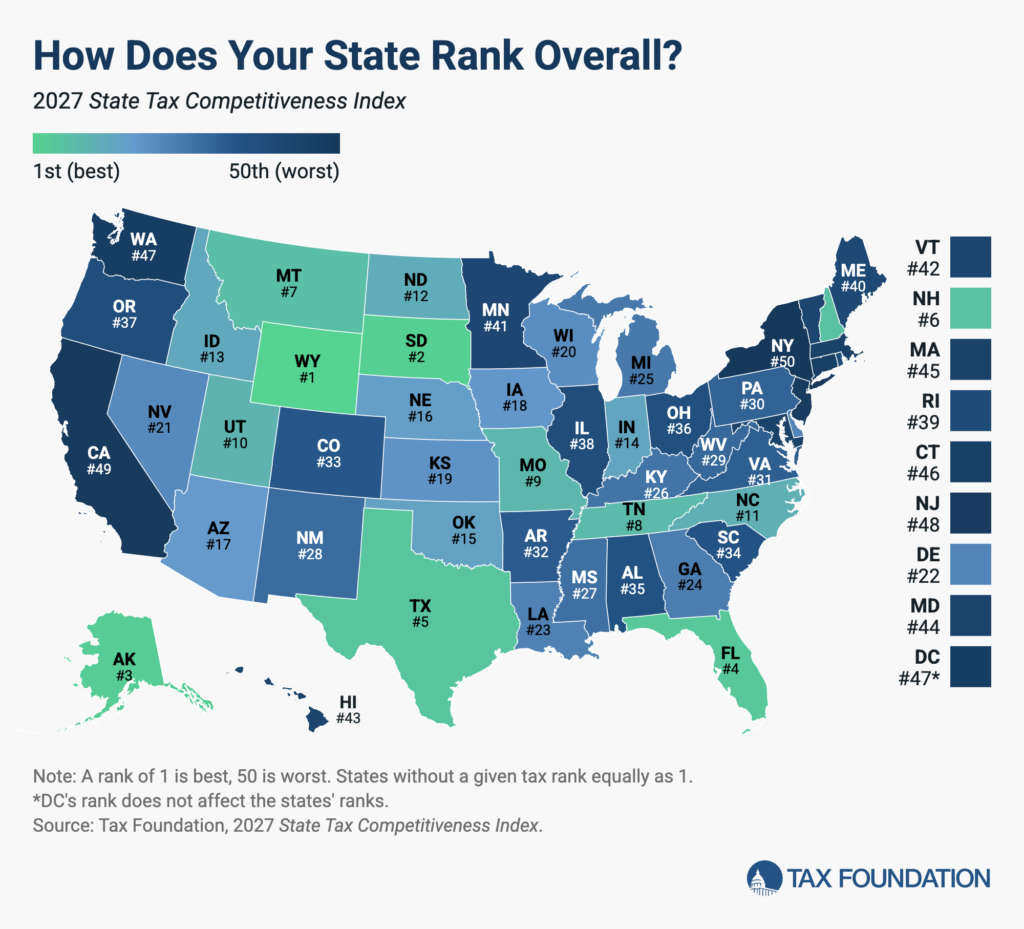
Without action, having one of the heaviest overall tax burdens in the country will continue to push residents to lower-cost, lower-tax areas. If employees don’t want to live here, that means businesses may be less likely to bring operations here, on top of other issues like relatively burdensome corporate taxes. Fewer people living and working here translates into less taxable income to cover the bill for important state programs and services.
Competitor States Lowered Taxes
Voters elsewhere made moves to lower taxes on Election Day.
North Carolina voters approved an income tax cut from 3.99% to 3.5%. It also requires voters to approve another constitutional amendment to increase this rate.
Florida voters approved a measure that would decrease property taxes by increasing the amount of a home that can be exempted from property taxes. The measure also reduces the limit on how much the assessed value of properties that are not someone’s home can increase every year.
In a historic vote, California voters struck down a tax on all assets over $1 billion, based on the latest vote tally. Another competing measure, which prohibits new taxes on retirement holdings, savings, and personal assets, appears to be approved by voters.
Conclusion
The debate over Question 5 raised real concerns about the sustainability of Massachusetts’ high cost, high tax environment. And its near win suggests Bay Staters are eager to address issues of affordability and rapidly rising state spending.
MOA will continue to analyze existing trends and advocate for new solutions to improve Massachusetts’ ability to attract and retain residents, employers, investment, and jobs.
More from Mass Appeal
Competitiveness Is On the Ballot in 2026
Competitiveness issues aren’t limited to the Bay State this election season. We highlight a few tax-related measures to watch across the country.
A Competitive Massachusetts Paves the Way For Charitable Giving
Massachusetts is home to some of the most innovative and successful individuals and companies in the country. When these big-dollar donors are looking for charitable programs and nonprofits to support, they often do so right in their own backyard.
Tax or Treat? The Scariest Ideas For Massachusetts’ Economy
Just in time for Halloween, MassBudget released its list of 28 ways to raise taxes on the Commonwealth’s families and businesses. What could be scarier than that?

Want to learn more about opportunity in Massachusetts?